Saturday, December 6, 2014

Do the Same Ideas Still Matter 200 Years Later?

Iran and the United States are currently engaged in a head-to-head over Iran’s nuclear weapons. It is hard to see how the debate will end, because neither side are willing to bend very far, or accommodate the other in the slightest.

Vice President Joe Biden, on behalf of President Barack Obama vowed, “The United States will not sign a bad deal”, and the debate over Iran’s nuclear weapons has been extended several months in order for them to keep this promise. The United states believes that under no circumstances should a deal be signed giving Iran easy access to their weapons. They believe they need an agreement in which Iran, if they decide to proceed with a nuclear attack, would not be able to follow through with the attack for at least several years, giving the United States (or other target) more time to deal with the potential of an attack and to hopefully be able to stop it. The United States and other world leaders involved want to drastically reduce Iran’s weapon stockpile, ideally even lessening to an amount too small to even make one bomb. The other parts of the deal for Iran including full-time security surrounding all nuclear activity in the country, and setting standards to stop Iran from using them as military devices. One of the largest reasons the United States needs Iran to sign this agreement, is because they fear that if the are too lenient with Iran, other Middle Eastern countries will begin to engage in nuclear programs as well. Because Iran does not seem to be responding to the offer of money, it is thought that the United States will have to move to their next plan of action: threatening a military strike. However, they only want to threaten a military strike; if the United States actually has to enter into combat against Iran, the global safety will be put at extremely high risk.
The Monroe Doctrine was put into effect in 1823 and was designed to give the President guidance on how to handle different foreign policy situations. This document helped leaders know when to interfere in foreign affairs and when to stay out. The basic principle in the doctrine still apply to today. One of the ideas written in the doctrine is non-intervention unless our country is being directly affected. This situation is not in our country, but it does have a strong effect on us. If no one was working to stop Iran, they would bomb several countries including ours, and the loss would be devastating. Although it is Iran’s business, the United States is as risk, which makes t also our business.

When the doctrine was written, nuclear warfare was not a concern two hundred years ago, but the ideas they wrote it to protect the country, and it is still being used in the same way today.  

Yadlin, Amos, and Avner Golov. "How to Avoid a Bad Deal With Iran." Foreign Policy How to Avoid a Bad Deal With Iran Comments. Foreign Policy, 3 Dec. 2014. Web. 06 Dec. 2014.

Monday, December 1, 2014

Racism in the 1800s and Now


The Mexican war for independence took place from 1810-1821. When Napoleon conquered Europe, he put his brother on the throne of Spain, which affected the Spanish colony of Mexico. He was supported by the Creoles (American-born Spanish), but opposed by the Spanish-born Spanish, or Peninsulares. Father Hidalgo, a revolutionary leader, led a failed peasant revolt with support from the Creoles. After this failed attempt, a new leader, Father Morelos began a revolt without the help of the Creoles. After this successful rebellion, General Iturbide took the Mexican throne, uniting the Creoles and Mestizos both against the Peninsulares, but his position was not long-lasting. Once Mexico was freed from Spain, he was overthrown and a republic and military coup was created. The issue of race and the identity characteristics it gave people was most prominent when considering the causes of the independence war. The Creoles and Mestizos (mixed Spanish and Indian heritage) were unhappy with way the Peninsulares were treating them. The Peninsulares were given the highest ranking jobs with the government or church, and a large number of them were extremely wealthy. The Creoles and Mestizos did not have the same opportunities, both usually working on mines or haciendas, but the largest and richest ones were often given to the Creoles over the Mestizos. The lower ranking people were fed up with their treatment, and that is why they joined the revolution, with hope that the new society they would be creating would be fairer to everyone.


On August 6, 2014, 18-year-old Michael Brown, a black teen living in Ferguson Missouri was shot and killed by a white police officer, Darren Wilson even though he was unarmed. The entire country watched the case unfold. On Monday, November 24, the jury found Wilson not guilty of murder, a decision that was met with protest and anger from residents of Ferguson and surrounding areas in Missouri. Darren Wilson was forced to resign from his duties for fear of his safety. For the next week, violent protesters took to the streets, but the largest protest took place on Black Friday. Michael Brown Protestors Urge Shoppers to Boycott Black Friday, an article written Elisha Fieldstadt tells readers how two dozen upset citizens met in front of a Wal-Mart chanting “no justice, no peace, no racist police, no more Black Friday”, but soon evacuated when they were met with threats of arrest. The crowds reassembled later in the day and began illegally blocking off streets and staging “die-ins” which is where the protesters lay down like dead bodies. At least 16 people were arrested.

A die-in staged on Black Friday
I think this article, and the entire Michael Brown case shows us how racism is still very much alive in our society. Several witnesses told the Brown was unarmed. The two became involved in a physical altercation which is when Wilson fired his gun twelve times, with six shots hitting Brown. I do not believe he should not have been shot, and certainly not six times. The Brown family has the opportunity to pursue a civil lawsuit against the Ferguson Police Department, but have yet to indicate whether or not they will proceed. The situation has brought about a lot of questions. Would the officer have fired if the teen had been white? Are there more unfair interactions between a black and a white officer than a white and a white officer? A survey of black Americans stated that 70% percent of them felt that they were treated unfairly in legal situations with police compared to whites. However, it has also been found that for every one murder by a white person, there will be eight committed by a black, and that is why there is such a heavy police presence put in blacks. The situation is complex because there are different factors and no easy answer. I do believe the Brown case was unfair, but agree with statements saying there was very little evidence for either in favor of either side.

 Fieldstadt, Elisha. "Michael Brown Protesters Urge Shoppers to Boycott Black Friday." NBC News. N.p., 29 Nov. 2014. Web. 30 Nov. 2014.


Wednesday, November 5, 2014

Holy Alliance and Intervention at the Congress of Vienna


Prince Metternich
http://www.emersonkent.com/images/klemens_von_metternich_bio.jpg

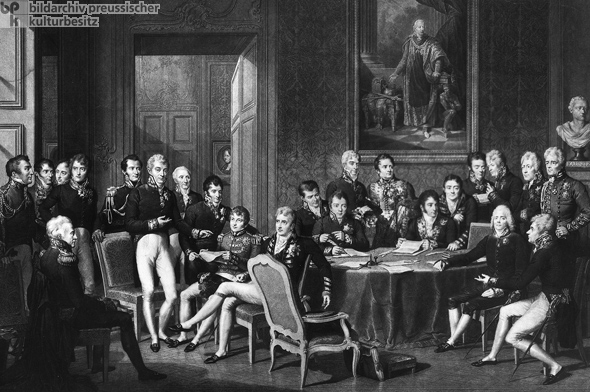
The Congress of Vienna took place in Vienna, Austria when Napoleon Bonaparte’s rule of Europe ended. A representative from each country affected by Napoleon's rule was in attendance, including princes, tsars, and other influential leaders. There were several problems that still needed to be fixed, and several questions that still needed to be answered. Should they re-establish the hereditary monarchies? How could they make the countries more peaceful and prevent similar future incidents? The attendees had the power to make these decisions for all of Europe. Our class activity was to read through the different scenarios and try to decide which solution was best. We acted as Prince Metternich, a representative from Austria and had to make our choices based on what would be fair to both Austria and the other affected countries. We then learned which of the scenarios was actually correct and it was very interesting to see if our thinking was the same as the representatives that attended the Congress of Vienna, and were actually responsible for these problems, or if it was vastly different.
Metternich and the other leaders present at the Congress of Vienna were worried about how they would be able to handle more possible revolutions in the future. They used principles such as Holy Alliance and Intervention to provide safety for their governments. They worked together to create an alliance, which became known as the Quadruple Alliance, and later the Quintuple Alliance. They issued a statement that made the slave trade illegal and made civil rights available to Jews. By making more groups of people happier as giving them more rights, they hoped it would lead to less uprising from suppressed people. They wanted to make a plan to prevent revolt instead of dealing with it after it happened. They decided to put monarchs back on the thrones. They believed these rules were chosen through “the grace of God”. The leaders hoped to scare the citizens and considered any act against the rules treason against both the country and God.
I agree that forming an alliance between the countries most deeply affected by Napoleon, and that attempting to create more equality for slaves and Jews were both smart ideas made by the leaders. However, I do not think they should have re-established the monarchies. They feared that their power could be threatened or even removed by the citizens. They should have created a fairer government that had the best interest of the people. Because the powerful people were in charge of these decisions, they were not willing to sacrifice their power, and I would have thought that in a situation like this, after Europe was destroyed by Napoleon, these people would have been looking out for more than just themselves. They should have been more willing to give up some of their power if it meant their citizens would be benefiting. There are many different options that could have consisted of the representatives still keeping some of their power, but allowing the voices of the people to come through.
The Congress of Vienna
http://germanhistorydocs.ghi-dc.org/sub_image.cfm?image_id=255

Sunday, October 19, 2014

Napoleon's Political, Social, and Economic Influences


Napoleon sometimes made bad decisions, but much his overall impact, especially regarding France was positive. He is often pictured as a cruel man who was greedy for power, but he did improve the quality of life in France and the other countries that he conquered. One of Napoleon's opposers, Madame de Stael, a member of nobility, described Napoleon as having “profound contempt for all the intellectual riches of human nature: virtue, dignity, religion, enthusiasm: in his eyes they are ‘the eternal enemies of the continent’”.  She and other like her were opposed to Napoleon because many of the high-ranking nobles, including her father who was the former financial advisor of King Louis XVI lost their jobs. Although Madame de Stael was against Napoleon, he had many followers. Marshal Michael Ney was one of Napoleon's followers. He was a soldier in his army and experienced Napoleon's skill and combat strategy first hand. He described Napoleon as an “august emperor” and “immortal legion”. He believed that “to the emperor Napoleon, our sovereign, belongs alone the right to rule over our beautiful country”. In order to see his overall impact, we have to break it up into social, economic, and political.

One area in which Napoleon was looking out for the best interest of Europe and not just France was in politics. He took over virtually every European country but Britain, but he tried to improve them all. In every country, Napoleon did away with all noble titles. He also ended the Church’s long tradition of having an excessive amount of power. Napoleon took a special interest in Egypt when he traveled there, and created an entirely reorganized system of government. In every country he was responsible for, Napoleon created systems that were more fair and had more benefits for ordinary people, not just leaders and nobles.

Napoleon also had great success with economic reform. He worked hard to improve the economy of France to benefit the general population. Napoleon encouraged trade by creating new canals and roads to make the transport of goods easier and removing all trade barriers. He encouraged new industries to grow. Napoleon was able to bring the French budget to a good balance during his rule and created new jobs to give more citizens work to support themselves. Unfortunately, not every way that Napoleon tried to restore the economy was beneficial to everyone. At one point in the French Revolution, he stole priceless artwork and an enormous amount of money from Italy. Looking at the situation from an Italian perspective, it was not a good move, but Napoleon’s job was to improve the economy in France, and in that regard, he was a success.

Lastly, Napoleon also changed the social aspect of the country of France. During his rule over France, he dissolved the idea of social classes and replaced it with a system known as a “meritocracy”, where the citizens were rewarded by their skills and not their social class. This new system made people more equal and gave them more chances. You could have the same opportunity at success as someone born to a family who had previously had a higher social standing. Napoleon also made sure that more citizens had the same rights to own property as everyone else. He also worked to improve the education systems not only in France but also in the other countries he conquered. He gave all citizens equal rights to a proper education and in Egypt, opened the Institute of Egypt, which focused mainly on the study of ancient Egyptian culture. Napoleon made everyday life easier for the people he ruled over and gave more opportunities to everyday people. He had a positive influence on the social life of France and all the countries under his rule because he improved the quality of life for his people.

Napoleon did not always go about his reforms in the best ways, but he had the people’s best interest, especially the people of France. His influences were positive because he changed all of these countries for the better.

Wednesday, October 8, 2014

Was Ned Ludd Real? And How The Luddites Affected The Factories

The Luddites were very skilled artisans such as weavers, mechanics, and other craftsmen that often attacked machinery and factories during the early industrial revolution. Contrary to popular belief, the Luddites were not actually protesting against technology. They were upset over the economic hardship that these machines were causing for society. Wages were being reduced because the work the factory employees were doing needed less skill. The Luddites protested “The Man”, and the fact that factory owners had more power over their workers. The Luddites got their name because they considered themselves followers of the fictional “Ned Ludd”. Ned Ludd never actually existed. He was a character in a make-believe story that the Luddites say occured 22 years prior. The story goes that an apprentice named Ludham was working at his machine and was criticized for his work not being good enough. Ludham became very angry, so he used a hammer to wreck the machine. The story went around and he became the symbolic leader of the Luddites.  The picture of Ned Ludd is false because he was a completely fictitious leader of the Luddites.

King Ludd
A drawing of the fictional Ned Ludd leading the Luddites

Below is a letter written to a cousin in America about what was happening in the English mill towns during the time of the Luddites.

Dear Mary,
As you probably know, I went to work in the factories just a few months ago.  It is a good job, not too hard, and I get paid enough to afford room and board with a little left over. Unfortunately, I am a little afraid that  my job will not last much longer.  Two factories around me have already been forced to close because all of their machines have been broken to pieces by a group of people known as Luddites. The Luddites do not like that wages are being cut and people are being fired and replaced by machines. They snuck into the two factories after dark and destroyed the machines. The factory owners had not choice but to fire the workers, not because they are to blame, but because without machines, there is no work to be done by them.
I do not support the Luddites. I do feel badly that their jobs and the economy are at such a risk that they have to resort to violence. However, I  have to think of myself and I am afraid they will come after my factory next. I will not have any choice, but to return to the family farm should my job be taken away. Although I do not make a large wage, it is a substantial help to my family, and helps them afford more than just necessities. We were talking this morning at breakfast in my boarding house about what we would do should our factory be shut down. Some girls will try to find new jobs, and they will have an advantage because of their experience. The majority of us believe we will just return to the country and go back to helping our families. I still have hope that this is a choice I will not have to make, because I hope my place of employment will not become a target for the Luddites.
Say hello to the whole family in America for me.
Sincerely,
Molly

Thursday, October 2, 2014

What Did the Lowell Mills Show About the Roles of Women in the 19th Century?

As a young woman working on a family farm, there were many reasons why you might want to go to work in the factories. It benefited your family in more than one way, such as giving them one less mouth to feed. The girls were often paid a very good amount, and the money was often sent back to the family, and could be used to save for things such as a dowry, so the girl could one day get married and also to help pay off the family's mortgage loans. Working in the factory could also help benefit a girl's future. They would get good work experience, and while living in the mill city, could even meet a man to marry and start a family with. The girls were also benefited. They were given a room to stay in and three meals a day at a boardinghouse for a small price. The work was monotonous but not terrible, and they could afford more than just necessities. Both the girls and the factory owners benefitted because the women were a cheap labor source, and easy for the factory workers to come by.
The jobs given to the women in the Lowell Mills were difficult but easy to pick up on from women with more experience. Common jobs included spinners, warpers, weavers, drawers, and dressers. Although the girls who came to the factories from family farms were used to hard work and long days, the mill work was a completely different experience for them. A regular day of work at a mill lasted around 13 hours. For six days of this, which equaled about 78 hours, they would only be paid somewhere around $3.50, but a good portion of this money went to their room and meals in the boarding house they lived in.

No matter how well the factory was advertised, it didn't always live up the expectations. "Oh! Isn't it a pity such a pretty girl as I should be sent away to the factory to pine away and die? Oh! I cannot be a slave, I will not be a slave, for I am so fond of liberty that I cannot be a slave." This is part of a song that was sung by Lowell women strikers who were not happy with wage cuts and the overall treatment they received. As "daughters of free men", the women believed there were certain right they were entitled to but were being denied by the factory workers.

The first organized protest in Lowell was a strike that occurred in 1834. The workers became outraged when it was announced that there would be a 15% pay cut, but they would still expect the women to complete the same amount of work. 800 women walked it of their jobs and took to the streets to defend themselves and their positions. However, there were many girls willing to come in and work, and the workers were easily replaced. In 1836, the workers went on strike again, and this time they were successful. They were angered by the announcement that the boardinghouse rates would be changed and made higher. They were better prepared this time, and even began shutting down parts of the factory. It took several weeks to wear them down, but factory owners eventually gave up and put the original prices back in place.

The women had to fight for their freedom and voice under difficult circumstances. They had no work unions, because at the time women were usually exempt from these organization, so they had  no help in working for their cause. They eventually did create a trade union and an organization called "Workingmen's Parties" to help them fight to gain back their independence. The women were able to work together very well, because they were all fighting for the same cause. Being together all day in the mills and all night in the boarding houses helped them form strong friendships and gave them the ability to trust each other, which made the later strikes end in their favor.

All the mill overseers and owners were men, and in the early to mid-1800s they were considered to be far superior. It was a difficult task for the women to have themselves takes seriously and to have people listen to their ideas. During this time period, the general population was discovering that both men and women had their own roles to benefit society. Many of these beliefs were contradicted because it was widely thought that women, especially in the middle class should be working at home to maintain the house and family, and going to the factories and joining the working class was quite different for them. The women strongly thought that working in the mills was a way to show people that they could push the limits of how they were supposed to be living and how they were fighting to give other women more freedom and options for their lives.


Wednesday, September 17, 2014

Spinning the Future: A Woven Dream & Other Industrial Revolution Topics

My Group Poster
My Honors History 10 class recently learned about the Industrial Revolution. To help us better understand the topics, we were split into groups and each group was assigned a different idea of the Industrial Revolution and created an exhibit. We used different kinds of sources including articles, pictures, and charts. 

The poster pictured is the project that my group worked to create. Our topic was mainly about spinning in the Lowell Mills, but we also talked about cottagers and how they were affected by the Industrial Revolution, hand looms, and the effects of the Industrial Revolution on London's population. My favorite section that out group covered was learning about cottagers, and how their business was unfortunately ruined by the Industrial Revolution. Cottagers were people that spun cotton in their own houses, and that way they were able to run a successful business, raise a family, and do other household chores all at the same time. However, when cotton factories were brought to America, the factories were able to produce cotton at a much quicker rate, and there was little to no business left for the cottagers. Another very interesting point was the chart on our poster that showed the growth in London's population as the Industrial Revolution grew. As more and more people began moving to the city to create new job opportunities, the population rose quickly. We also learned about the spinning wheel, and John Almond's Hand loom. Overall, my group worked very well today and created a very good project.

The hourglass picture seen on the
 "Cotton or Freedom" exhibit
Looking at the posters that the other groups made helped me to understand different aspects of the Industrial Revolution that weren't a part of my project. I learned about the steam engine in the exhibit "Hot Stuff: how the steam engine fired up the Industrial Revolution" and how it made travel and trade both faster and easier. Many people were skeptical of the steam engine at first because it was such a new and modern invention. The steam engine caused man-made canals to be created, because people wanted to create shorter ways for the engines to get places. The steam engine exhibit also included a timeline that showed the development of transportation. Another interesting exhibit was "Cotton or Freedom". This project talked about the role of slaves and slavery in making cotton in factories. When slaves were first brought to the factories, there were 500,000 of them working, and within 90 years, that number skyrocketed all the way to 4,000,000. The slaves produced cotton, the cotton produced money, the money was used to make more factories, and new factories meant they needed new slaves to work in them. The picture of the hourglass here was on the poster and is a visual representation of the slaves doing all the work to create money for the factory owners.

The next exhibit I saw was about child labor during the Industrial Revolution. The children working in the factories dealt with horrible conditions that were both unhealthy and unsafe. However, it did not stay this way forever. These issues were addressed in the Factory Act of 1883 which worked to create a better working environment for children and also limited the amount a time a child could work, which could not exceed 12 hours a day and 69 hours per week. The last project showed that although the Industrial Revolution was a great time for technology, it also created many issues for others. A large issue was the pollution created by the factories. The pollution was in both the water and the air, and was so bad that in the 19th century the sun was not even visible. Also, during the Industrial Revolution, the cost of living was high and the salaries were low, and in most cases they were not even, meaning many people had to give up everyday necessities of their daily lives.
I learned a lot from both my project and the ones created by others. It was a fun and interesting way to learn about the Industrial Revolution.